
For much of the history of Brazilian confectionery, the concept of the 'sweet' was tied to memory, celebration, and the ingredients available in each region. But over the course of the 19th century, a new reference point began to grace the tables, pâtisseries, and social habits of Brazilian cities: France.
More than just recipes, what arrived were new ways of preparing, presenting, and understanding gastronomy. Techniques, equipment, professionals, and products crossed the Atlantic, while French culture came to represent an ideal of refinement, modernity, and sophistication for a segment of Brazilian society. In the confectionery shops of Rio de Janeiro, this influence could be seen in their names and menus, as well as in the presence of pâtissiers from France and equipment imported from Paris.
The French presence, however, did not signify the disappearance of Brazilian traditions. On the contrary, upon encountering local ingredients, customs, and palates, these new references were adapted, transformed, and incorporated into a gastronomic culture that already had its own deep roots.
It is precisely at this intersection that a significant chapter in the history of Brazilian pâtisserie begins. It is a story not only about sweets, but about how a society came to see gastronomy also as a matter of technique, aesthetics, experience, and cultural expression.
To understand contemporary Brazilian pâtisserie, therefore, we must return to this moment when France and Brazil began to meet at the table.
When France Arrived at the Brazilian Table
The connection between France and Brazil strengthened throughout the 19th century, a period of profound transformation in Brazilian society. Rio de Janeiro, then the Empire's capital, was growing as a political, economic, and cultural center and, in its own way, mirroring the changes taking place in major European cities. In this context, France came to occupy a special place in the imagination of the elites and in new spaces of social life.
French influence was not limited to literature, fashion, or architecture. It also reached the dining table. Restaurants, cafés, and confectionery shops began to use French references in their names, advertisements, and menus, associating their products and services with an idea of refinement and modernity. Research on food in Rio de Janeiro between 1854 and 1890 shows that French cuisine was one of the most recurrent foreign references in the city's establishments at the time.
Pâtisseries played a particularly important role in this process. More than just places for selling sweets, these establishments were part of the new urban life, also functioning as spaces for gathering, leisure, and social distinction. To frequent them could represent an alignment with habits considered modern and sophisticated in a city striving to present itself as increasingly cosmopolitan.
The French presence could be perceived in a very tangible way. The Confeitaria Francesa, for example, advertised Parisian bread and Provençal bread in 1853, prepared by a newly arrived French baker. The following year, the establishment promoted a chef-pâtissier from France and a series of creations that were then little known in the city, including brioches, nougats, savarins, and babas.
A reference to France also served as a kind of certificate of distinction. In other establishments, professionals who had traveled to Paris made a point of presenting what they had learned in the city to their clients, while equipment and raw materials arrived from Europe to expand production possibilities. A machine imported from Paris, for instance, was advertised during the period as capable of producing confectionery and chocolates of a quality comparable to the finest European houses.
Pâtisseries as Showcases of Modernity
In 19th-century Rio de Janeiro, confectionery shops began to occupy a space that went beyond the simple sale of sweets. In a city that was transforming and expanding its social spaces, these establishments became part of urban life, blending food, leisure, and sociability. Frequenting them could also signify an embrace of habits considered modern, refined, and cosmopolitan.
France held a special place in this collective imagination. In a society seeking European references to accompany its cultural and urban transformations, a French connection functioned as a sign of distinction. It is no coincidence that advertisements for restaurants and pâtisseries frequently used the French language, the names of French preparations, and highlighted the presence of professionals trained in or recently arrived from France.
This association could also be perceived in the very experience offered by the establishments. The pâtisseries brought together sweets, breads, meals, drinks, and products for parties, often taking on roles that today we would recognize as belonging to different segments of gastronomy. Some even offered services for dinners, balls, and other celebrations, preparing desserts and other items to order.
The ambiance also contributed to this perception of distinction. Some houses were frequented by members of the highest echelons of society, while others catered to a broader public. There were, therefore, different types of confectionery shops, but the association between these spaces and an idea of refinement was present in the very way many of them presented themselves to the public.
In this context, the French reference was not just on the plate. It was also in the way the establishment was presented, the products were named, professionals were hired, and a consumer experience was constructed. The confectionery shop was thus becoming a kind of showcase where the public could experience not only new flavors, but also new codes of behavior and sociability.
It is interesting to note that this transformation was happening at the same time as these pâtisseries were incorporating other references. Italian and Portuguese products, as well as ingredients and preparations associated with different Brazilian regions, also found a place in these establishments. The result was not a Brazilian pâtisserie that was simply French, but an environment where different traditions met.
This ability to bring together distinct influences would be fundamental to the formation of Brazilian pâtisserie. France offered techniques, references, and a new concept of presentation; Brazil, in turn, offered its own ingredients, habits, and flavors. Between these two worlds, a new language began to emerge—one that, over time, would cease to be merely a reproduction of what came from Europe and would become genuinely Brazilian.
The French Pâtissier and the Transformation of Sweet-Making
The French influence on Brazilian pâtisserie did not arrive only through the sweets that appeared on the counters of confectionery shops. It also came through the hands of professionals who brought with them different techniques, repertoires, and ways of working. In 19th-century Rio de Janeiro, advertisements for establishments made a point of highlighting the arrival of pâtissiers, chefs, and bakers from France, presenting this European experience as a differentiator for their clients.
A particularly revealing example appears in advertisements for the Confeitaria Francesa. In 1854, the establishment announced a "skilled chef-pâtissier" recently arrived from France, responsible for preparations that were still little known in the city, including brioches, nougats, savarins, and babas. Months later, another ad highlighted a French pâtissier who was sourcing new raw materials and products from Europe to offer sweets, pastries, and confections with flavors considered new and delicate.
The presence of these professionals represented more than the introduction of new recipes. The work of a pâtissier involved knowledge of techniques, control of processes, mastery of equipment, and a different understanding of finish and presentation. The very arrival of machines from Paris for producing confections and chocolates shows how this transformation also involved the means of production, not just what was served to the consumer.
At the same time, this knowledge began to circulate in other ways. Between the second half of the 19th century and the first decades of the 20th, several technical manuals dedicated to confectionery and sweet-making were published in Rio de Janeiro, some aimed specifically at professionals and others at home cooks. The existence of this publishing market reveals that the art of sweet-making was beginning to be treated as a body of knowledge that could be organized, taught, and reproduced.
This professionalization helped to broaden the repertoire of Brazilian pâtisserie. European techniques and preparations began to coexist with local ingredients and customs, while Brazilian professionals learned, adapted, and transformed what arrived from abroad. The French influence, therefore, was established not only through the presence of foreign pâtissiers, but also through the circulation of knowledge that remained long after these professionals had left their establishments.
From Influence to Identity
Over time, what arrived in Brazil as a foreign reference ceased to be perceived merely as a French influence. Techniques, forms of presentation, preparations, and a new way of understanding the work of the pâtissier were incorporated into daily gastronomic life and became part of the very language of Brazilian pâtisserie.
This transformation is important because a cultural influence does not necessarily remain a copy of its origin. When it finds new territory, it undergoes adaptations, combines with other repertoires, and, gradually, can acquire new meanings. In Brazilian pâtisserie, French references went through this same process.
The very language used in the professional sphere reveals part of this permanence. Terms like pâtisserie, mousse, ganache, praliné, and petit four remain present in the vocabulary of Brazilian pâtisserie, often designating preparations that have already been fully incorporated into the local repertoire. More than just foreign words, they have become part of a gastronomic language recognized by both professionals and consumers.
The same is true for the high value placed on technique and finish. Precision, attention to proportions, care with textures, and presentation came to occupy an important place in the perception of quality within the world of confectionery. These elements do not belong exclusively to the French tradition, but the French pâtisserie tradition was instrumental in disseminating and valorizing this way of thinking about the sweet as a creation that demands knowledge, method, and technical mastery.
Throughout this process, however, Brazil did not fail to create its own identity. Local ingredients, regional flavors, and traditions that existed before the arrival of these references remained present and were incorporated into the new techniques and forms of presentation.
It is precisely in this combination that influence ceases to be just influence and begins to become identity. Contemporary Brazilian pâtisserie is not a reproduction of French pâtisserie, but neither can it be fully understood without acknowledging the references that helped to shape it.
The result is a pâtisserie capable of engaging with an international tradition of technique and precision, while at the same time preserving the diversity of ingredients, flavors, and histories that belong to Brazil.
When an Influence Becomes Custom
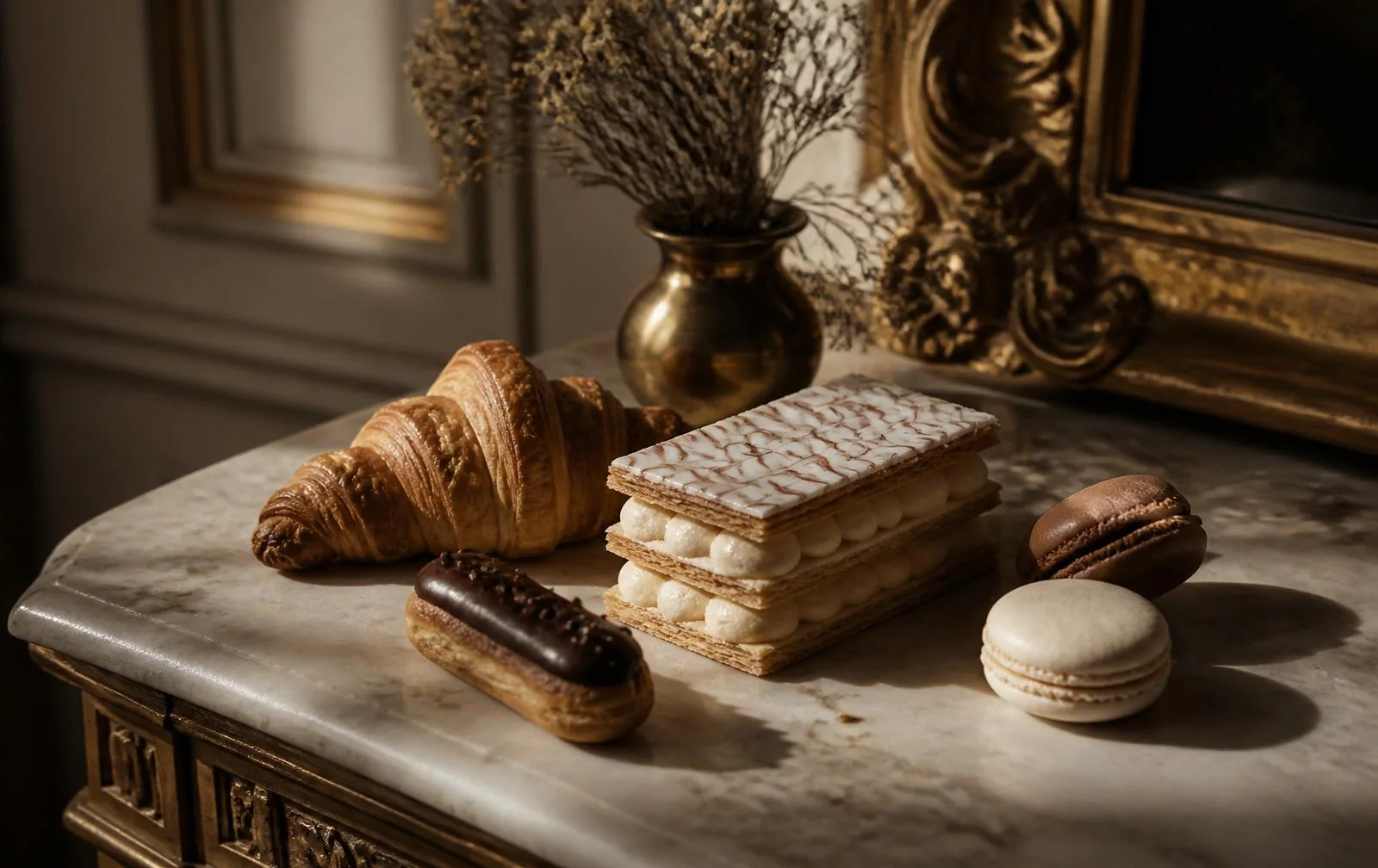
Some creations that now seem completely natural to the Brazilian repertoire carry a history that crossed the Atlantic. The croissant in its French form, puff pastries, brioche, the éclair, the mille-feuille, the madeleine, the petit four, the macaron, and so many other creations are part of the world of contemporary Brazilian pâtisserie, often without their French origin even being remembered.
This incorporation did not happen all at once. It was the result of decades of circulation of recipes, professionals, techniques, and gastronomic references. As early as the 19th century, pâtisseries in Rio de Janeiro were advertising creations like brioches, nougats, savarins, and babas, in addition to breads associated with Paris and Provence. The presence of these products in Brazilian establishments shows how early the French repertoire began to be part of the urban gastronomic experience.
Over time, this presence expanded beyond recipes. The French tradition also helped to consolidate a particular way of working with doughs, creams, fillings, and finishes. Puff pastry and lamination techniques, for example, became part of a much broader repertoire of preparations, while the culture of viennoiserie helped to bring breads and fermented doughs closer to the world of confectionery.
It is interesting to note that when a creation becomes part of a country's daily life, its origin can cease to be evident. A Brazilian consumer may immediately recognize a croissant, a mille-feuille, or a madeleine, but may not always think of them as foreign preparations. The same happens with words that have become common in the professional vocabulary, such as mousse, ganache, praliné, and petit four.
This naturalization is one of the most profound forms of cultural influence. It is no longer a matter of presenting something as a French novelty, but of incorporating it into the repertoire itself. The creation crosses borders, encounters new ingredients, new habits, and new contexts, and, little by little, comes to be recognized simply as part of what one eats.
In Brazil, this process was particularly fertile because French references met a sweet-making culture that already had its own traditions and ingredients. The result was not the disappearance of one in favor of the other, but the creation of an ever-expanding repertoire in which creations of different origins began to coexist.
Perhaps this is precisely why the French influence remains so present. It is not just in the sweets we still call French, but also in those we have incorporated so completely that we have stopped asking where they came from.
Perhaps the most profound influence is precisely the one that no longer seems like an influence.
Some influences are so deep that they cease to be perceived as influences. They become part of everyday life, language, and customs.
Perhaps this is the best portrait of the French presence in Brazilian pâtisserie: not what remained foreign, but what, after crossing the Atlantic, became part of our own tables.


Get our next editorials.
Receive the next issues of the Observatory, along with trends, stories and exclusive LEBBEKE content, straight to your inbox.
No spam. Unsubscribe anytime.